Chapter 18
Music Theory and The Fretboard: The Harmonic (Overtone) Series
What is so fascinating about intervals is that they occur in nature!
Introduction to The harmonic (overtone) Series
Scientists and music theorists like Pythagoras (6th century BCE) used tools like the “monochord” to discover that certain intervals occur in nature. The monochord is like a single-string guitar with a moveable bridge that allows you to significantly reduce the length of the string. When you pluck a full length string and then pluck a second string that is exactly half in length of the first, the interval created between the two strings is an octave. They discovered that if you continue shortening the string in length (a third, a fourth, etc. of the original), each string creates a tone that is consonant to the previously played strings.
The very first tone produced by a full length string has a name: “the fundamental” or “first partial”. The second tone produced by a string half in length is called the “second partial” or “first overtone”. The third tone is called the “third partial” or “second overtone”. Relative to the second partial (or first overtone), it is up a 5th interval. The fourth partial produces a tone that is up a perfect 4th from the previous partial (the second overtone).

playing The overtone Series on the guitar
Here is how you play the first 3 overtones of the Harmonic Series.
- The open E string is the fundamental (or 1st partial).
- The harmonic at the 12th fret is the 1st overtone (or 2nd partial). It is up an octave (an 8th) interval and therefore it is the note E.
- The harmonic at the 7th fret is the 2nd overtone (or 3rd partial). It is up a fifth interval relative to the previous note and therefore it is the note B.
- And the harmonic at the 5th fret is the 3rd overtone (or 4th partial). It is up a fourth interval relative to the previous note and therefore it is the note E.
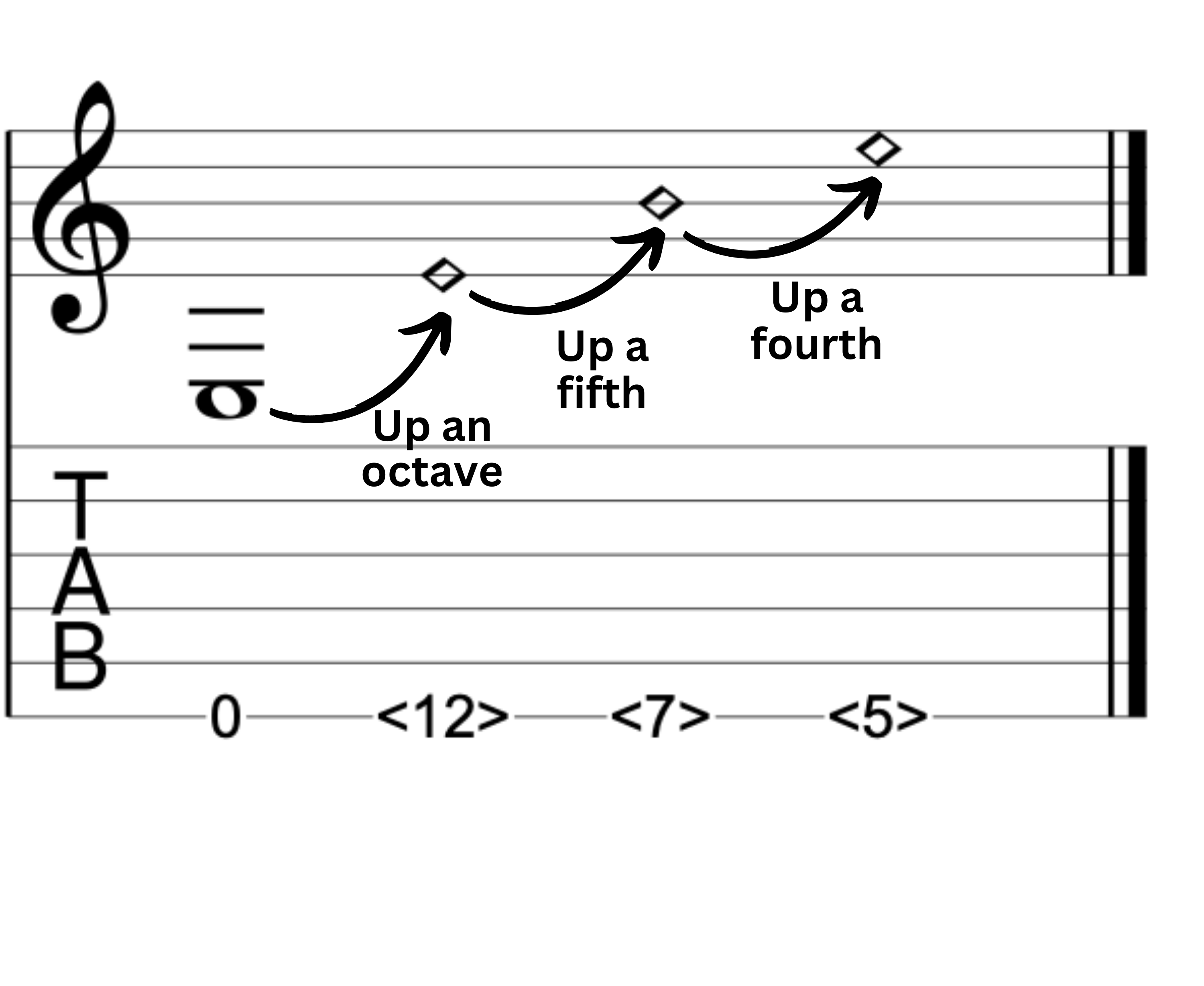 To play natural harmonics, lightly touch the low E string without fretting the string and pluck relatively forcefully for a full sound. You’ll play harmonics on the 12th, 7th, and 5th frets.
You may also have inadvertently discovered the overtone series when tuning your guitar. Other strings will sympathetically vibrate when you pluck the low E string. Sometimes your tuner will jump around and display notes other than “E”. These other mysterious notes are simply the tones from the harmonic series (overtone series). You can help your tuner out by muting the other strings with your free hand.