Chapter 4
The Fretboard: Names of the Strings (the notes they produce)
We could name each pitch by the frequency they produce. For example, “Will you play the 440 Hz note for me so that I can tune my Violin?”
Instead, we’ve given each pitch a name. An open string—a string played without pressing a fret—produces a note, and that note is also the string’s name.
Guitar standard tuning
From nose to toes, the guitar strings are E, A, D, G, B, and E again. This is called “standard tuning” or “E Standard”.
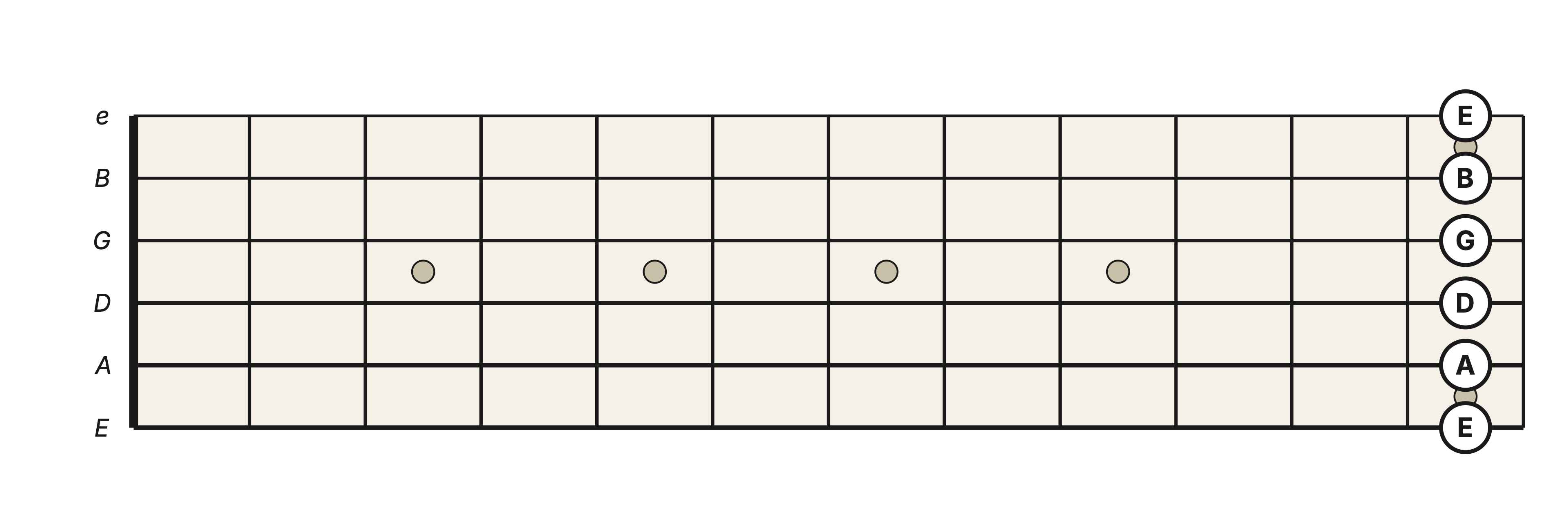
The thinnest string, the high E closest to your toes, is String 1. The thickest string, the low E closest to your nose, is String 6. The complete mapping is E (6), A (5), D (4), G (3), B (2), E (1).
These are the pitches guitarists have agreed to use as a common starting point. Other tunings exist, including Drop D and DADGAD, but this book uses guitar standard tuning.
Bass standard tuning
From nose to toes, the strings of a standard four-string bass are E, A, D, and G. This is also called “standard tuning” or “E Standard”.
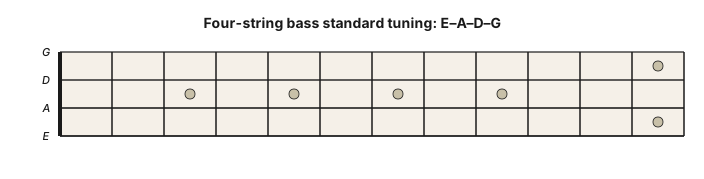
The thinnest string, the G closest to your toes, is String 1. The thickest string, the low E closest to your nose, is String 4. The complete mapping is E (4), A (3), D (2), G (1).
These are the pitches bassists have agreed to use as a common starting point. Other tunings exist, including Drop D, but this book uses four-string bass standard tuning.
Learn all four open-string names now. In Level 1, however, you will memorize fretted note locations only on E, A, and D. The G string may appear as the upper note of an interval shape, but its complete note map begins in Level 2.