Chapter 23
Music Theory: Why B–F is not a Perfect 5th
The interval B–F spans 5 note names. B (1), C (2), D (3), E (4), and F (5). Therefore, it is indeed a 5th interval.
But it’s a “Diminished 5th”, not a “Perfect 5th”. “Diminished” simply means one half step smaller than Perfect. As you know, a 5th is only Perfect when you traverse 7 half steps, and from B to F you only traverse 6. Use a single line of notes to count them, and remember to start counting from zero. B (0), C (1), unnamed black note (2), D (3), unnamed black note (4), E (5), and finally F (6). That’s only 6 half steps, one short of a Perfect 5th.

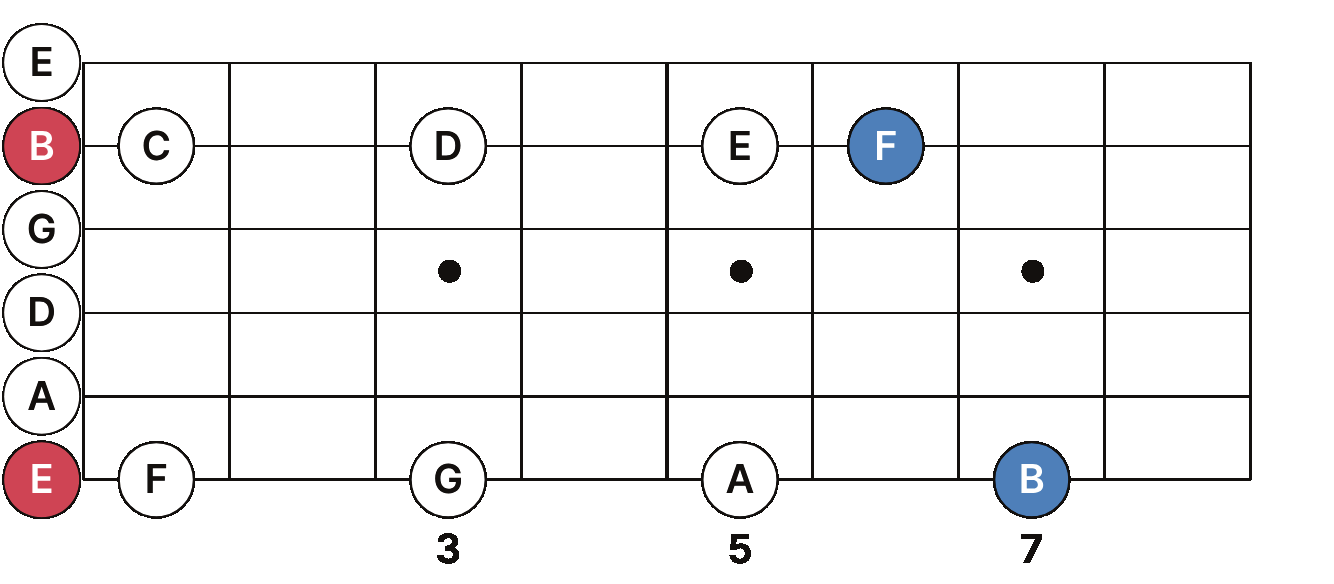
You can see the same thing on the fretboard. Compare the distance from E to B (7 frets) to the distance from B to F (just 6 frets). As discussed in previous chapters, E–B is a Perfect 5th, so B–F coming up one fret short is exactly what makes it Diminished.
The B–F interval, in the key of C, is the only 5th in the major scale that isn’t Perfect. Every other one (C–G, D–A, E–B, F–C, G–D, and A–E) is a Perfect 5th. And this isn’t special to the key of C. The 5th built on the 7th scale degree is always a Diminished 5th, in every Major key. It’s also the reason there are only 6 power chords in a key and not 7. You can’t build a power chord on the 7th note, because a power chord needs a Perfect 5th, and the 5th you get there is Diminished.
In summary, a 5th is only Perfect when you traverse 7 half steps. B–F traverses just 6, so it’s a Diminished 5th. And it will always be the 5th built on the 7th degree of the scale.