Chapter 25
Music Theory: Chord Voicings
A Power Chord consists of two notes, a 5th apart. For example, the two notes that comprise the C5 Power Chord are C and G.
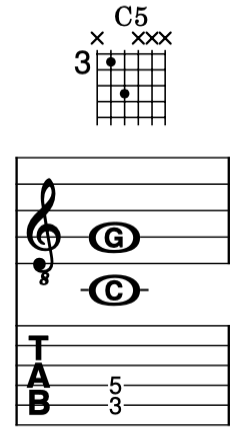
However, the note C also exists on the G string at the 5th fret. Many players add this extra C because it gives the Power Chord a fuller, thicker sound, like so:
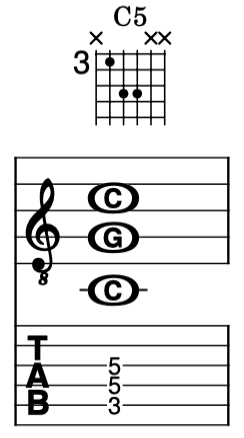
For bass: These C5 voicings use the same fret numbers on the A, D, and G strings. They sound one octave lower than the guitar examples.
This is still a C5 Power Chord because no new notes were added. It is still comprised of C and G even though we added an extra C. The extra C makes this a different “voicing” of the C5 Power Chord. A voicing is simply a particular way of arranging a chord’s notes: which ones you double, and in which octave you place them. (That extra C is just the root C an octave higher.) I can add as many C’s and G’s as I want, in as many octaves as I want, and it’ll still be a C5 Power Chord.
And this isn’t only a Power Chord idea. Every chord can be played in different voicings, something you’ll keep running into as you learn new shapes.