Chapter 1
Music Theory: Pitch
Sing any comfortable sound. While you hold it, let your voice slide upward and then back down. You can hear the sound become higher and lower. That higher-or-lower quality is called pitch.
You can also feel pitch move in your throat. As you sing higher pitches, your larynx rises in your vocal tract.


As you sing lower pitches, your larynx moves downward.
Now pluck the guitar’s thick, low 6th string. We will start with this string, then carry the same relationship over to bass.
The string vibrates and makes the air around it vibrate. You hear those vibrations as pitch. Slower vibrations sound lower. Faster vibrations sound higher.
A plucked string actually vibrates in several ways at once. Its lowest repeating vibration is called its fundamental frequency, and it largely determines the pitch you hear.
Frequency is measured in Hertz, abbreviated as Hz. One Hz means one complete vibration each second. The guitar’s open 6th string has a fundamental frequency of about 82.4 Hz. You do not need to memorize that number. We are only going to use it as a starting point.
Open the online tool at https://academo.org/demos/wave-interference-beat-frequency. Set one frequency to 82.4 Hz. Then make a copy of that frequency and double it:
82.4 Hz × 2 = 164.8 Hz
Listen to the two frequencies together. The 164.8 Hz pitch sounds higher, but it does not sound unrelated to the 82.4 Hz pitch. It sounds like a lighter shade of it. The two pitches “just fit.”
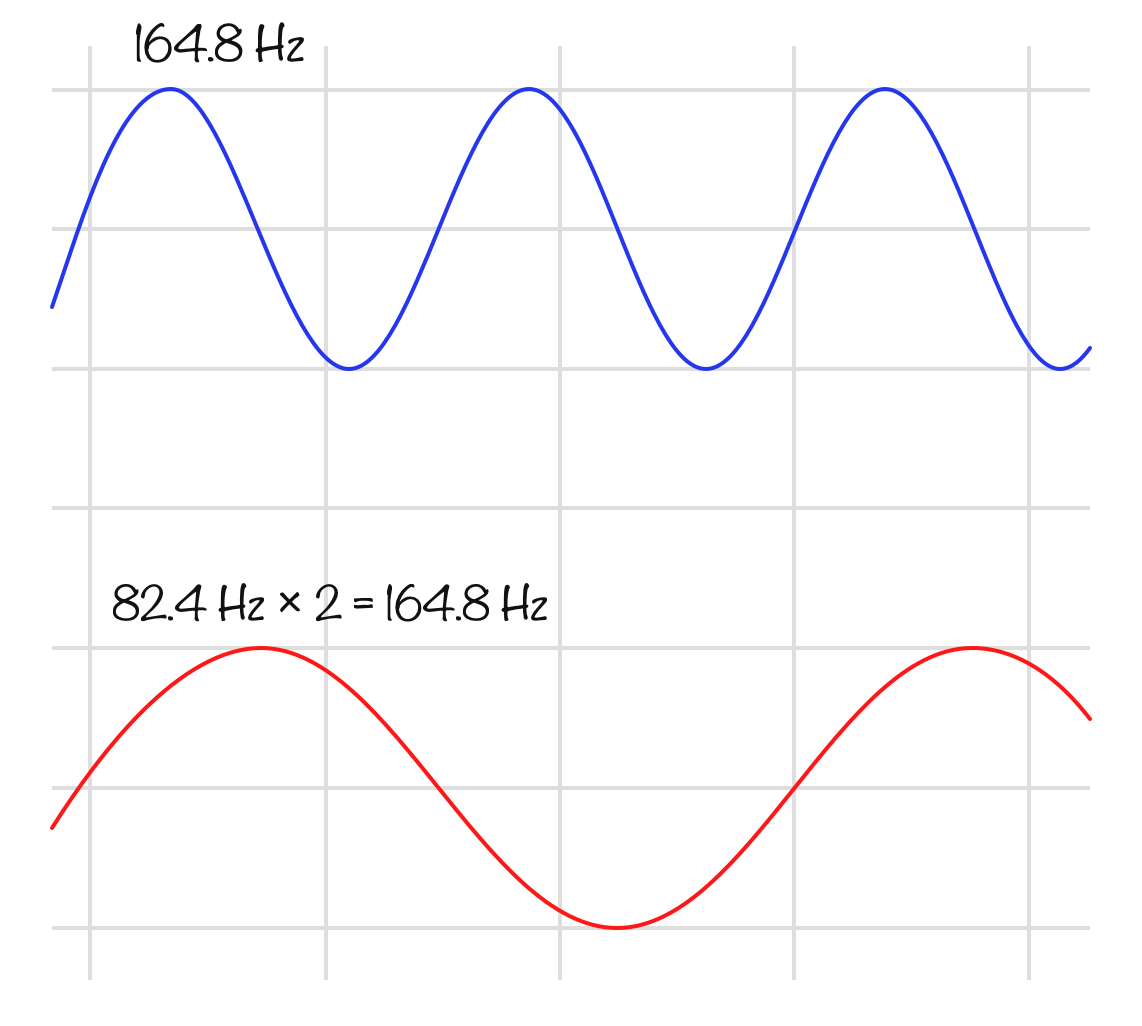
For now, remember the operation: doubling the fundamental frequency moves the pitch higher, while halving it moves the pitch lower. In both directions, the pitches still “just fit.”
Now double the frequency again. Start at 164.8 Hz and double it to reach 329.6 Hz: 164.8 × 2 = 329.6.
The lower wave in this graphic is 164.8 Hz. The upper wave is 329.6 Hz. Notice that the upper wave completes twice as many cycles across the same distance.
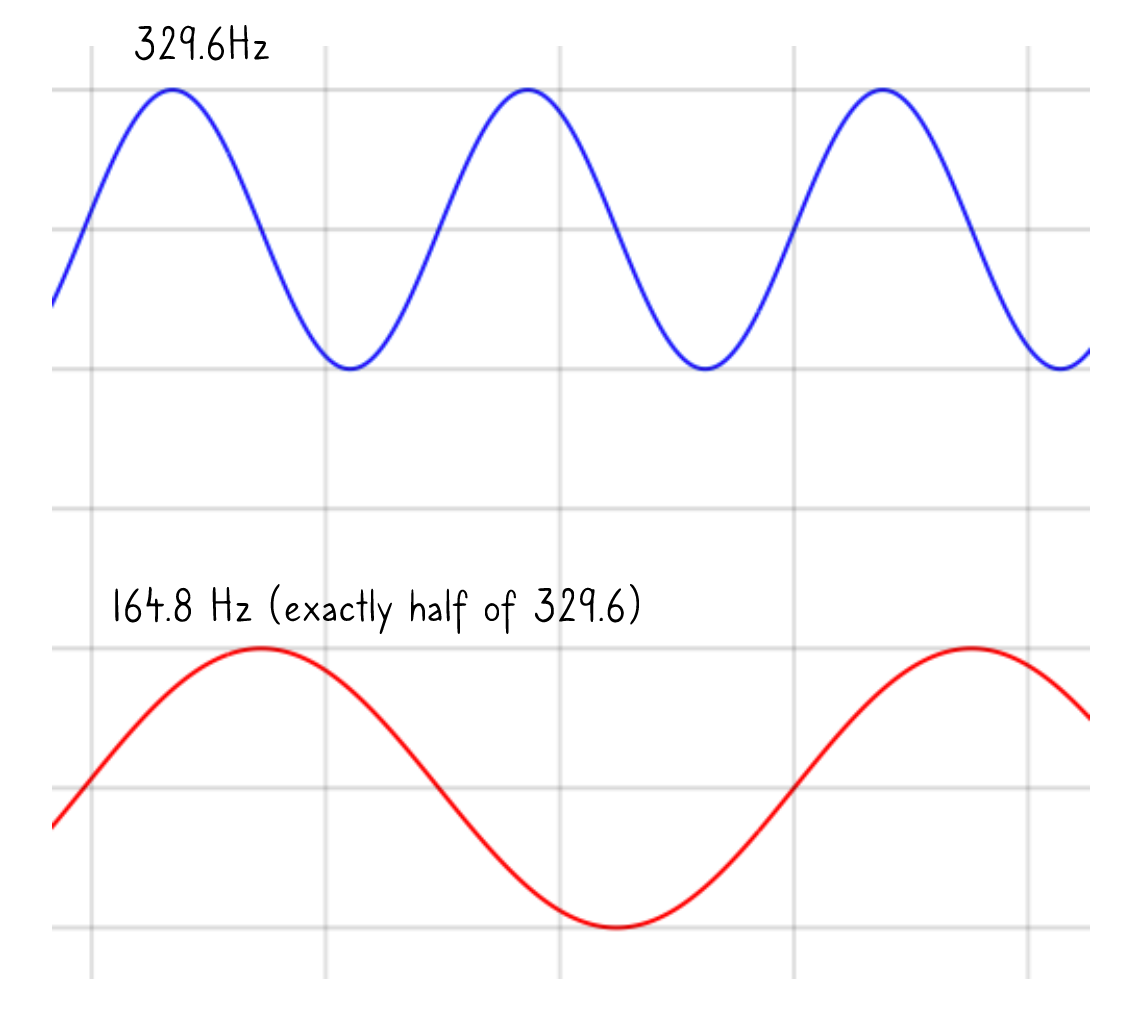
We started with the guitar’s open 6th string at about 82.4 Hz. After two doublings, we have reached about 329.6 Hz which is the fundamental frequency of the guitar’s thin, 1st string.
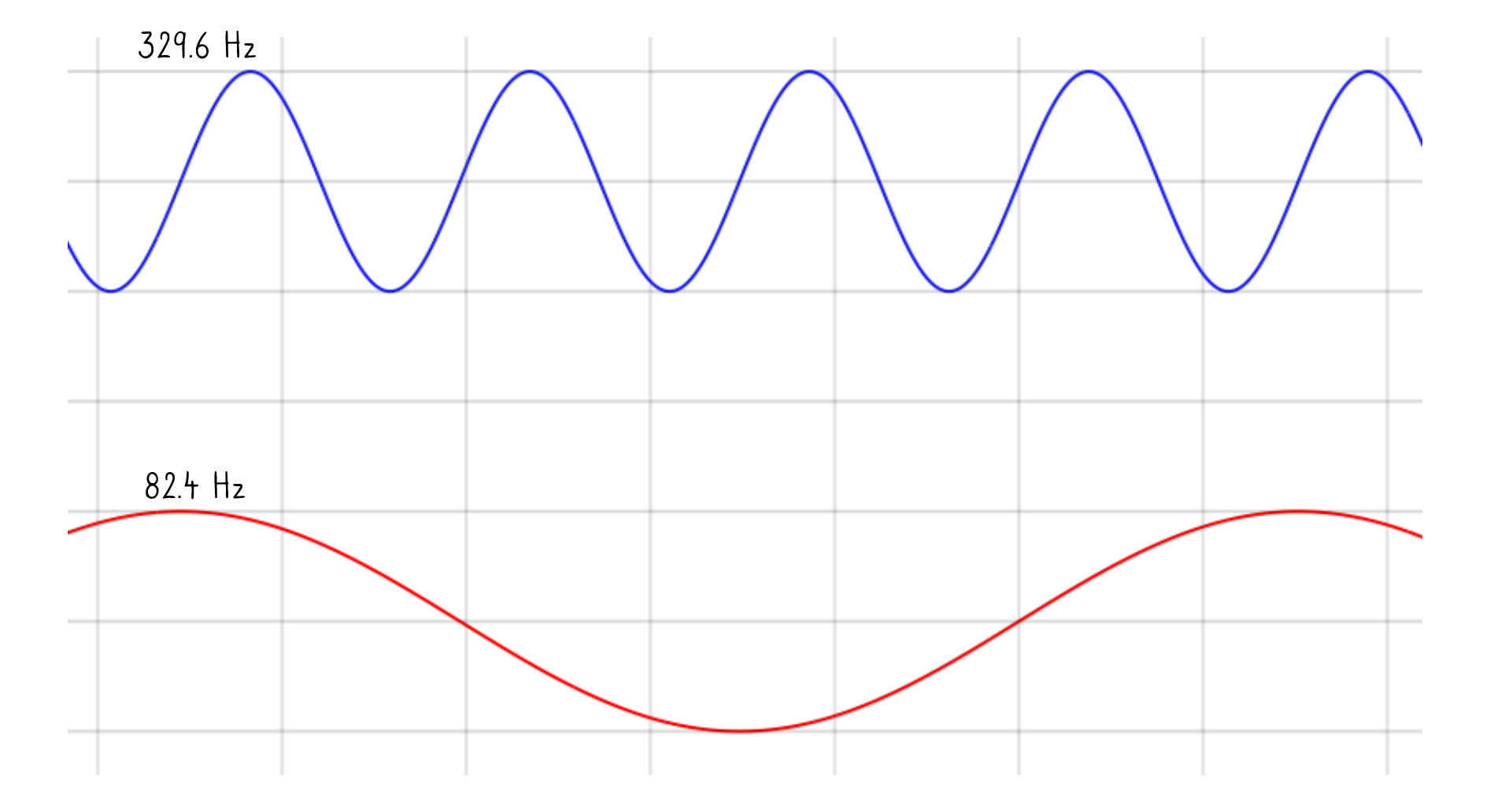
This graphic compares those two open guitar strings. The lower wave is the 6th string at about 82.4 Hz. The upper wave is the 1st string at about 329.6 Hz.
You can move from the 6th string’s frequency to the 1st string’s frequency by doubling twice: 82.4 × 2 × 2 = 329.6. Those two doublings connect the strings’ fundamental frequencies, which is why their pitches “just fit.”
Now return to our starting frequency of 82.4 Hz and go in the other direction. Halve it:
82.4 Hz ÷ 2 = 41.2 Hz
About 41.2 Hz is the fundamental frequency of the thick, low 4th string on a standard four-string bass. Its pitch sounds like a darker shade of the guitar’s 6th string. Those two strings “just fit” as well.
Put the whole relationship together, from lowest to highest:
Bass 4th string: 41.2 Hz → Guitar 6th string: 82.4 Hz → 164.8 Hz → Guitar 1st string: 329.6 Hz
Each arrow represents one doubling. In the other direction, each arrow represents one halving.
If you can, play the bass’s open 4th string, the guitar’s open 6th string, and the guitar’s open 1st string. The three pitches sit at different heights, but they sound as though they belong together. They “just fit” because they are connected by repeated doubling.
You may already know the name that these three strings share. We will get to note names in Chapter 3. For now, listen to what the frequencies do.
Guitar application
Play the open 6th string and let it ring. Then play the open 1st string. Listen for how the two pitches “just fit.” You can reach the 1st string’s fundamental frequency by doubling the 6th string’s frequency twice.
You do not need to memorize 82.4 Hz or 329.6 Hz. The important relationship is that the second frequency is reached by doubling the first one twice.
Bass application
Play the open 4th string and let it ring. If a guitarist is nearby, ask them to play the open 6th string. The guitar pitch sits one doubling above the bass pitch because the guitar string vibrates at twice the bass string’s fundamental frequency.
If you do not have a guitar nearby, enter 41.2 Hz and 82.4 Hz into the online tool and listen there. In either case, listen for how the two pitches “just fit.”