Chapter 34
Music Theory Exercises: Building the A, E, B, and F♯ Major Scales
Let’s build the A, E, B, and F♯ Major scales.
Exercise 1—The A Major Scale
In this exercise, I provide the natural notes from A to A on the A string, from the open string through the 12th fret. I also give you the major scale formula of 221-2221 above the A string. Notice the “2” between A and B? That is the first number of the formula, and it tells you to move 2 frets up the A string from A to reach the next note in the scale, B.
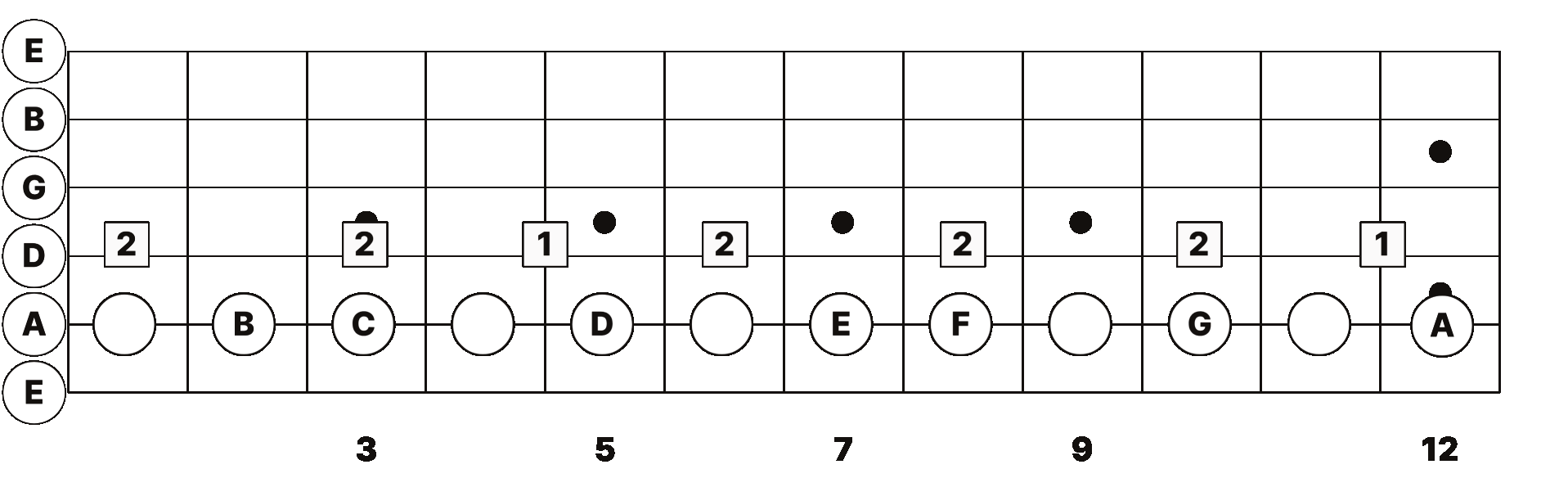
Guitar and bass: This exercise runs from the open A string to the 12th-fret A. Use only the A-string row and ignore every other string row. The fret locations are identical on both instruments, and the bass notes sound one octave lower than the guitar notes.
Determine which notes need to become sharp in order to fit the formula. I’ll give you a hint. There are 3 notes in the A Major scale that must become sharp. Write the notes of the scale and also the scale degrees:
| A | A | ||||||
| 1̂ | 8̂ (1̂) |
Exercise 2—The E Major Scale
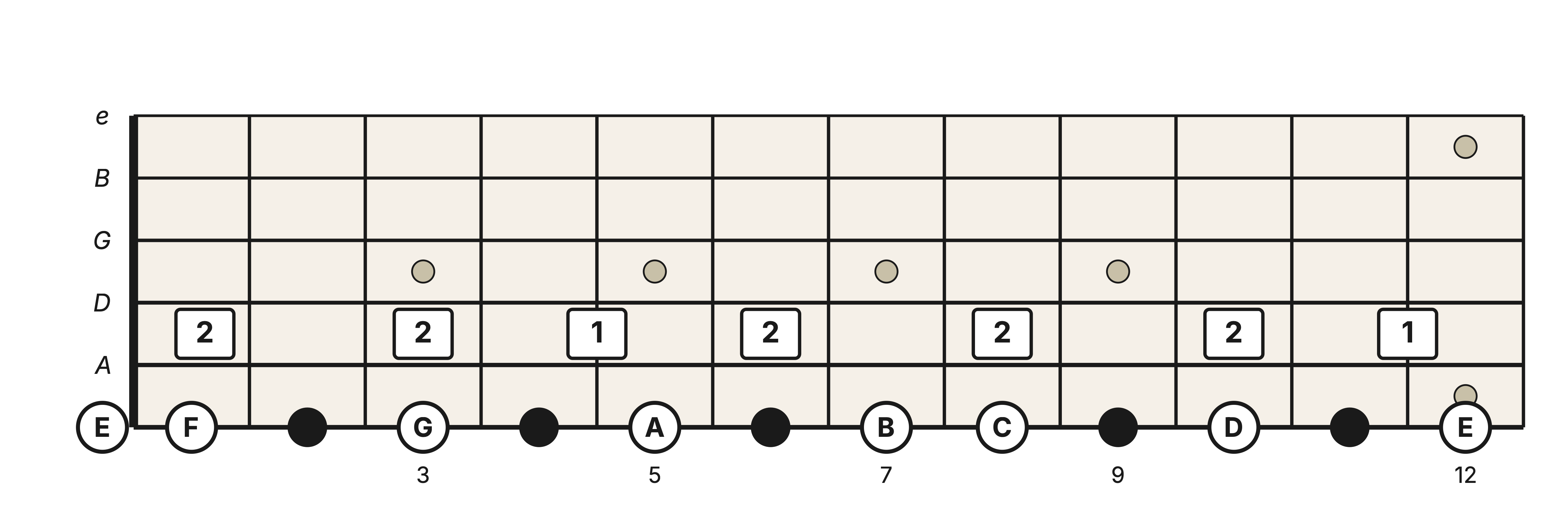
Guitar and bass: This exercise runs from the open low E string to the 12th-fret E. Use only the low E-string row and ignore every other string row. The fret locations are identical on both instruments, and the bass notes sound one octave lower than the guitar notes.
Determine which notes need to become sharp in order to fit the formula. Write the notes of the scale and also the scale degrees:
| E | E | ||||||
| 1̂ | 8̂ (1̂) |
Notice a pattern?
Before moving on, take note of how many sharped notes there are in each of the keys that we have studied so far. C has 0 sharps (of course). G has 1. D has 2. A has 3. E has 4. Notice a pattern?
What is the interval from C to G? C (1), D (2), E (3), F (4), G (5). C to G is a fifth. Similarly, G to D is a fifth. D to A is a fifth. And so on.
If E to B is a fifth, then that must mean the B major scale has just one more sharped note than E for a total of 5 sharps. And the F♯ major scale then must have a total of 6 sharps.
There’s also a pattern to which notes get sharped. The sharps always appear in this order: F♯, C♯, G♯, D♯, A♯, E♯. So A Major (3 sharps) uses the first three (F♯, C♯, G♯), and E Major (4 sharps) adds the next one (D♯). That order is itself a chain of 5ths: F-C-G-D-A-E.
One more thing, the note that is different between the C Major scale and the G Major scale is the 7th scale degree of the G Major scale. So a shortcut to create the G Major scale would be:
- Write out the C Major scale but start from G: G – A – B – C – D – E – F – G
- Make the 7th scale degree sharp: G – A – B – C – D – E – F♯ – G
Neat, huh?
So we now have the G Major scale written out. To create the D Major scale, write out the G Major scale but start with D.
- D – E – F♯ – G – A – B – C – D.
- Then make the 7th scale degree sharp. It is now D – E – F♯ – G – A – B – C♯ – D which is the correct D Major scale.
Exercise 3—The B Major Scale
- Write out the E Major scale beginning from B and ending on B.
- Make the 7th scale degree sharp.
| B | B | ||||||
| 1̂ | 8̂ (1̂) |
Exercise 4—The F♯ Major Scale
- Write out the B Major scale beginning from F♯ and ending on F♯.
- Make the 7th scale degree sharp.
Watch out: to keep all seven letter names, the 7th scale degree must be written as E♯ (which sounds the same as F natural), not F.
| F♯ | F♯ | ||||||
| 1̂ | 8̂ (1̂) |
Answer key
In every case the scale degrees run 1 through 8. The notes are:
- A Major: A, B, C♯, D, E, F♯, G♯, A (three sharps: F♯, C♯, G♯)
- E Major: E, F♯, G♯, A, B, C♯, D♯, E (four sharps: F♯, C♯, G♯, D♯)
- B Major: B, C♯, D♯, E, F♯, G♯, A♯, B (five sharps: F♯, C♯, G♯, D♯, A♯)
- F♯ Major: F♯, G♯, A♯, B, C♯, D♯, E♯, F♯ (six sharps: F♯, C♯, G♯, D♯, A♯, E♯; the 7th is E♯, not F)