Chapter 29
Musical Application (Note Recall + Power Chords): Playing Along with Songs
Zombie by The Cranberries is a useful first play-along because its repeating progression—Em, CMaj7, G6, and G6/F♯—is easy to follow. Guitarists can simplify each chord to a Power Chord, while bassists follow the roots E–C–G–F♯.
The fretboard memorization exercise from Chapter 16 can be a bit boring. Here is a musical way to apply what you’ve memorized so far.
Simplify the progression
- For Em, play E or E5
- For CMaj7, play C or C5
- For G6, play G or G5
- For G6/F♯, play F♯ or F♯5
Bass practice: Start with the single roots E–C–G–F♯ on the E, A, and D strings. Then play the progression with octave shapes or Power Chords.
Because each root appears in several locations, choose positions that make the progression comfortable. The examples below show two ways to play E5–C5–G5. For the final F♯, try a single note, an octave, or F♯5.
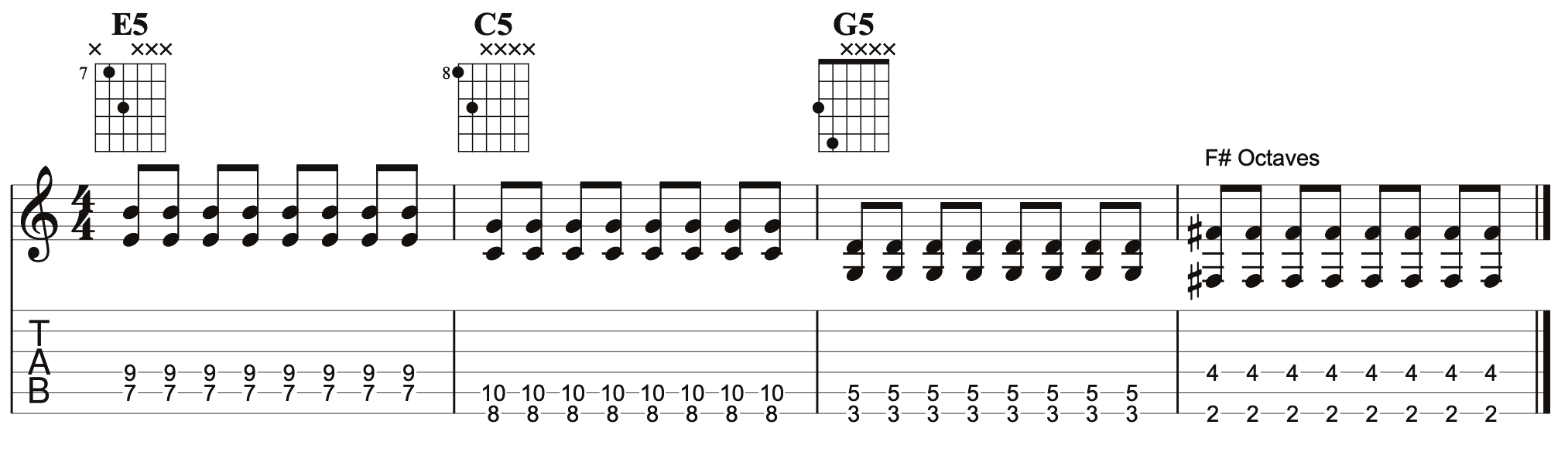
Alternatively, you can play these power chords in a different location like so:
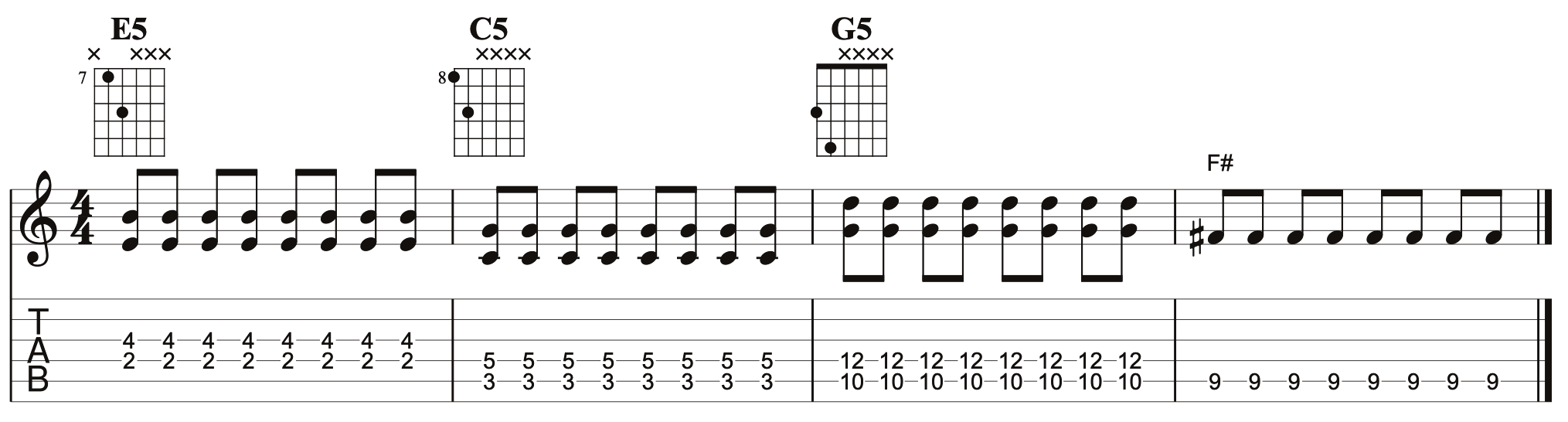
It’s totally up to you. You could even practice keeping all of the root notes on a single string.
This exercise is especially worth it when you encounter chords you do not know how to play. For now, ignore the suffix and extract only the root note. Then apply the power chord shape. Here are a few more conversions:
- Dmaj7 or Dma7 become just D5
- E7, E9, E11, or E13 all become E5
- Am7, Ami7, Amin7, or A-7 all become A5
- For any diminished-looking chord symbol, ignore the suffix and extract only the root note. For example, if you see C°7, then just play the single note C.
Side note: this is only a survival shortcut. We will discuss chord symbols more carefully in Level 2 (triad chord symbols) and Level 3 (7th chord symbols).