Chapter 30
Music Theory: Intro to Sharps, Naturals, Key Signatures, and the G Major Scale
So far, we’ve been learning and discussing the key of C, including the C Major scale, Power Chords, and chord progressions in that key. The notes in the key of C are called “natural” notes. In reality, the full and complete name of each note is “C natural”, “D natural”, etc. However, most people will leave the “natural” part of the name off and just simply say “C”, “D”, etc.
The musical symbol for “natural” is ♮. So if we’re being unnecessarily pedantic the C Major scale would be labeled like this:

There are a few other ways to name a note. Some notes can get a “sharp”.
Let’s learn a new scale by building the G Major scale (a major scale where the tonic is G). Because all scales must contain each note name, we’ll first cut out a G string from all the available notes like so:

We now have all 12 notes from G to G. The second thing we need to check is to see if the labeled notes follow the 221-2221 Major Scale pattern.

They do not.
As you can see, the green F is not in the scale. Instead the unlabeled black note just before G should be in the scale as a labeled, “rainbow” note. What is the name of that note? The way that music theory solves this problem is by calling that unlabeled note “F♯” (pronounced “F sharp”). A sharp raises a note by one half step, so F♯ is the note one half step above F. On a fretted guitar or bass, that means moving one fret higher on the same string. We still need to have all 7 letters represented in the scale. We also need to indicate that the note is not F♮(“natural”).

Now both major scale attributes are accounted for:
- The Major Scale must have each note name present. None are skipped and none are used twice. Even though the note, F, has a sharp symbol next to it, all 7 letter names are used (G, A, B, C, D, E, and F).
- The scale must follow the “221-2221” (or wwh-w-wwh) interval pattern.
Why preserve all seven letter names instead of giving every half-step position a separate letter? The Level 1 FAQ answers that question after you complete the sharp side of the Circle of Fifths.
Try playing the G Major scale on the G string like so:
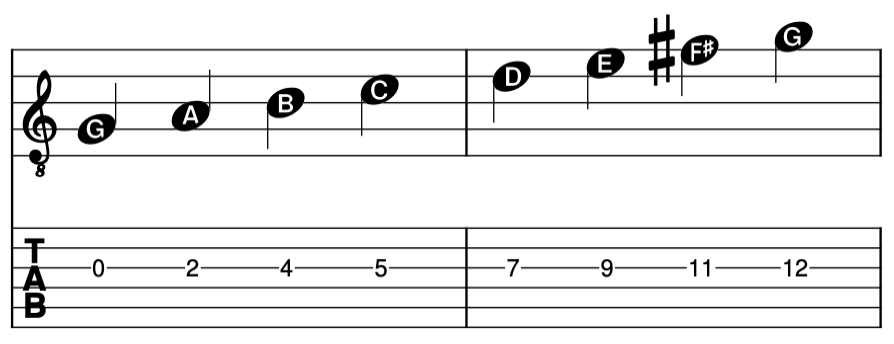
Guitar and bass: Both instruments have a G string with the same fret pattern. Play the open string, then frets 2, 4, 5, 7, 9, 11, and 12. The notes sound one octave lower on bass than on guitar. This is a scale-pattern exercise; Level 1 bassists still memorize fretted note locations only on the E, A, and D strings.
Key Signature
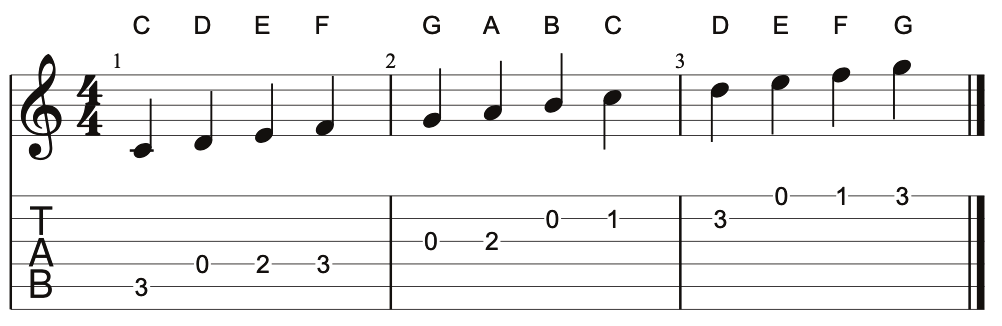
A “key signature” tells the performer which notes become a sharp or flat. An “accidental” is a sharp, flat, or natural sign placed directly in front of a note. Music written in the key of C has no accidentals indicated. Here is a simple ascending melody in the key of C:
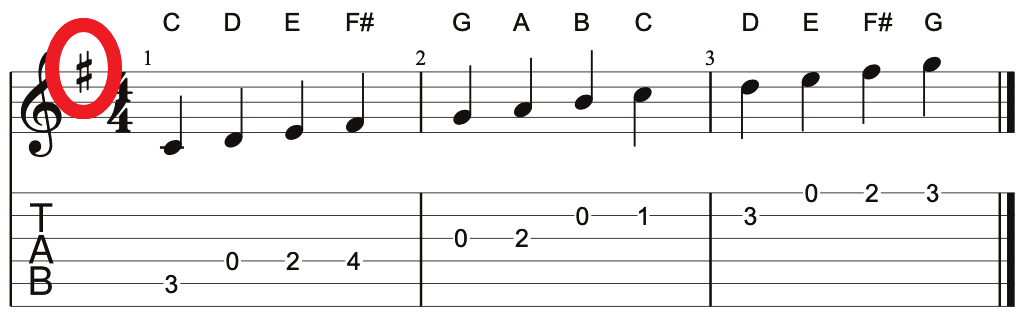
Now this piece of music is in the key of G. Music written in the key of G will have one sharp, F♯. In standard notation, only one sharp symbol is placed on the far left. The very top line represents the note F. However, all F’s will be sharped. That one symbol at the beginning saves the composer from having to mark a sharp in front of every single F throughout the piece.
In the guitar tablature above, the F♯ in measure 1 is played at the 4th fret of the D string. The F♯ in measure 3 is played at the 2nd fret of the high E string. The key signature applies to every F, no matter where it is played.
- The key signature for the key of G is: one sharp and that is F♯.
- The key signature for the key of C is: no sharps and no flats.
The natural sign (♮) has one more use. In a piece written in the key of G, if the composer wants you to play a plain F instead of F♯, they place a natural sign in front of that note. It cancels the sharp and tells you to play a plain F there.