Chapter 21
Music Theory: Chords In a Key
Most songs stay in a single key, and a song in the key of C is built mostly from the 7 notes of the C Major scale. So the power chords you’ll reach for when playing a song in C are exactly the ones you can build from that scale.
There are two steps you can do to figure out all of the chords in a key (this process is called harmonizing the scale):
- Write the Major Scale horizontally.
- Write the notes of each chord vertically.
So let’s find out all of the power chords in the key of C. First we’ll write out the C Major scale horizontally like so (I also included the scale degrees):
| Notes ➡ | C | D | E | F | G | A | B |
| Scale Degrees ➡ | 1̂ | 2̂ | 3̂ | 4̂ | 5̂ | 6̂ | 7̂ |
Here is the scale on a single string standard notation and tab:
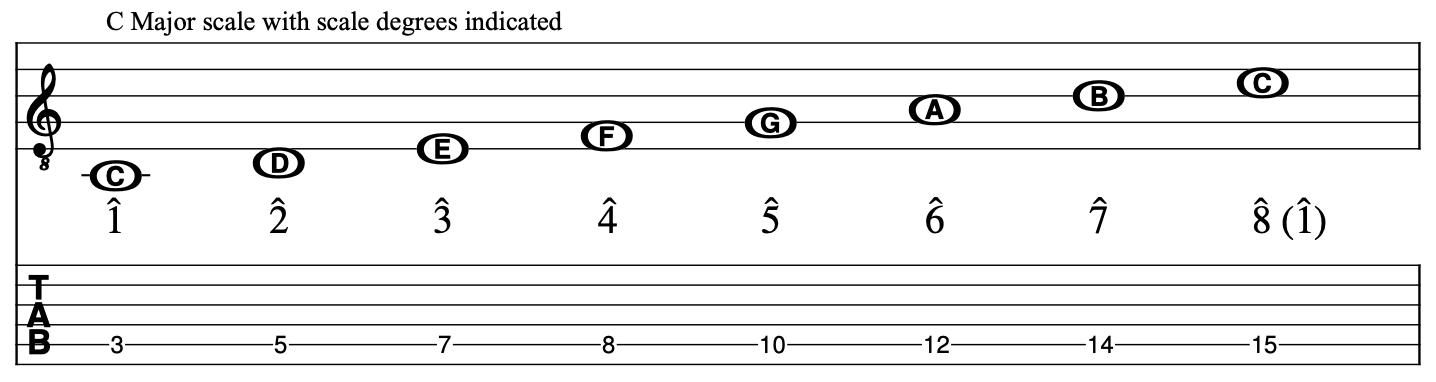
Next, for each note in the scale, find the 5th interval to build the power chord.
| Chord Degree ⬇ |
|||||||
| 5 | G | A | B | C | D | E | F |
| 1 | C | D | E | F | G | A | B |
As you can see, each note in the scale is a root note for each chord. The left column indicates the generic chord degree. Every chord has a “1” (or root) and a “5th” relative to the root. Chord degrees do not have the caret above the number. Scale degrees will have the caret.
In standard notation and tab:
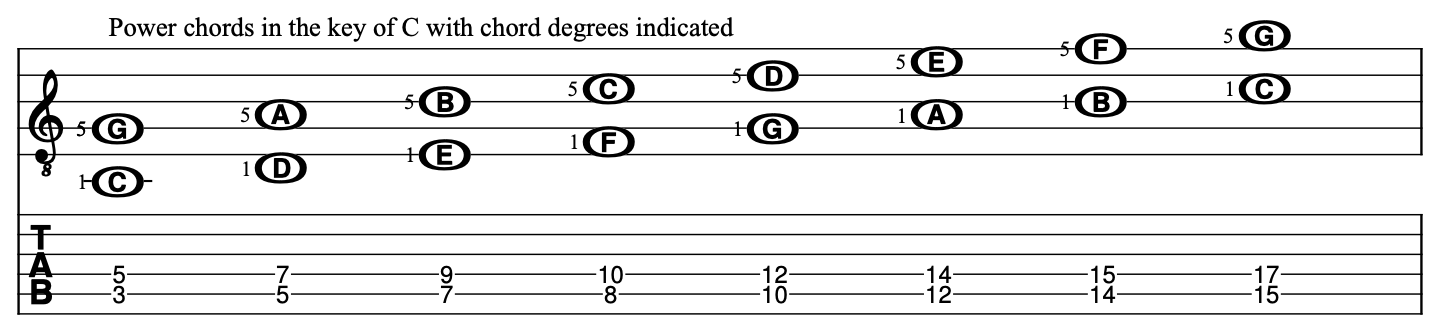
In standard notation, notice that you will always count a total of 5 lines and spaces from the root note in each chord to the 5th. For example, the “four” chord’s root note is F and is in the bottom space of the staff. From F to C, you count like so: space (1), line (2), space (3), line (4), space (5).
Chord Symbols
Chord symbols give you two pieces of information: the root note and the intervals needed to create the rest of the chord. You will typically see chord symbols (and chord diagrams) above the tablature (or standard notation). The first chord symbol we’ll learn about is the one for a Power Chord.
A power chord rooted on C is written C5. The root note is C. “5” indicates that you play, in addition to the root note, the 5th interval from C, which is the note G. That’s it. You only need to play those two notes in order to play the chord C5.
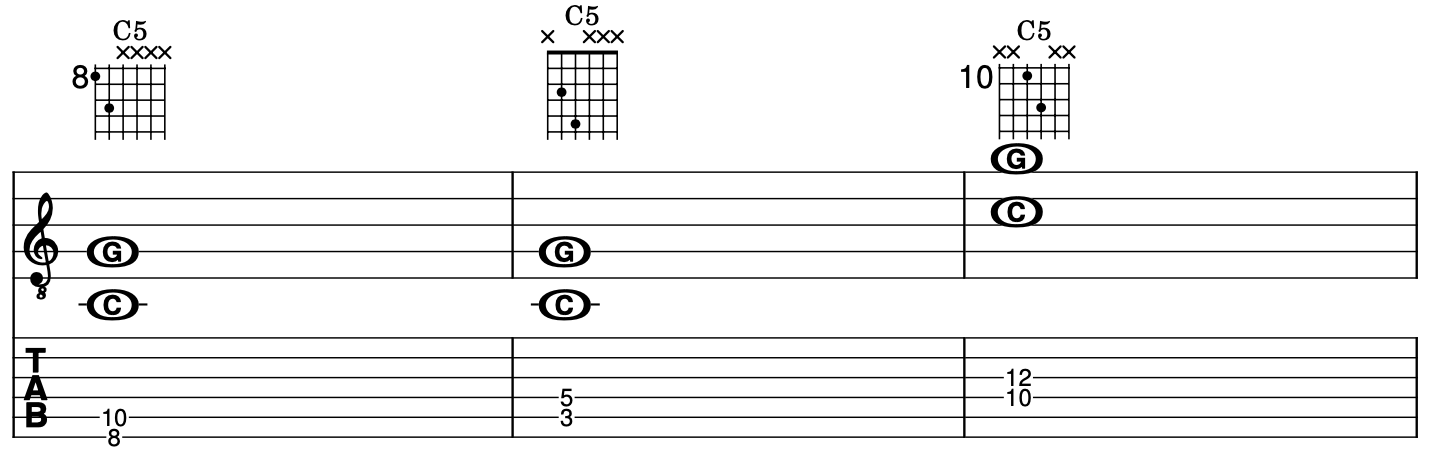
The 1st and 3rd diagrams above show you the fret number (8 and 10) where the root note lies. Sometimes, fingerings will be just below the chord diagram. In this case they are not indicated. Generally, I recommend using left hand fingers 1 and 3 to play a power chord. The 2nd diagram has a thick line at the top that represents the nut. Therefore there is no need to indicate a fret number.
Here is the Chords in a Key “matrix” with the chord symbols underneath each chord and the scale degrees in parentheses.
| Chord Degree ⬇ |
|||||||
| 5 | G (5̂) | A (6̂) | B (7̂) | C (1̂) | D (2̂) | E (3̂) | F (4̂) |
| 1 | C (1̂) | D (2̂) | E (3̂) | F (4̂) | G (5̂) | A (6̂) | B (7̂) |
| C5 | D5 | E5 | F5 | G5 | A5 | ?? |
I did not provide a chord symbol for the very last chord. I discuss why in Chapter 23.