Chapter 27
Music Theory: Inverting the Perfect Intervals
The Perfect Interval Family is:
- The Perfect Unison. It spans 1 note name and you traverse 0 half steps from the root tone to the next note in the interval.
- The Perfect 4th. It spans 4 note names and you traverse 5 half steps from the root tone to the next note in the interval.
- The Perfect 5th. It spans 5 note names and you traverse 7 half steps from the root tone to the next note in the interval.
- The Perfect 8th (or Octave). It spans 8 note names and you traverse 12 half steps from the root tone to the next note in the interval.
In this chapter, we’ll discuss what it means to “invert” an interval. There are only two notes in an interval (the lower note and the higher 2nd note). To invert an interval, simply change the position of the notes so the lower note now becomes the higher note.
G5 is G–D. The lower note is G. The higher note is D. To invert it, take the G and make it the high note. So now it is D–G. The low note is D. The high note is G.
Take a moment and analyze the interval D–G. How many note names does it span?
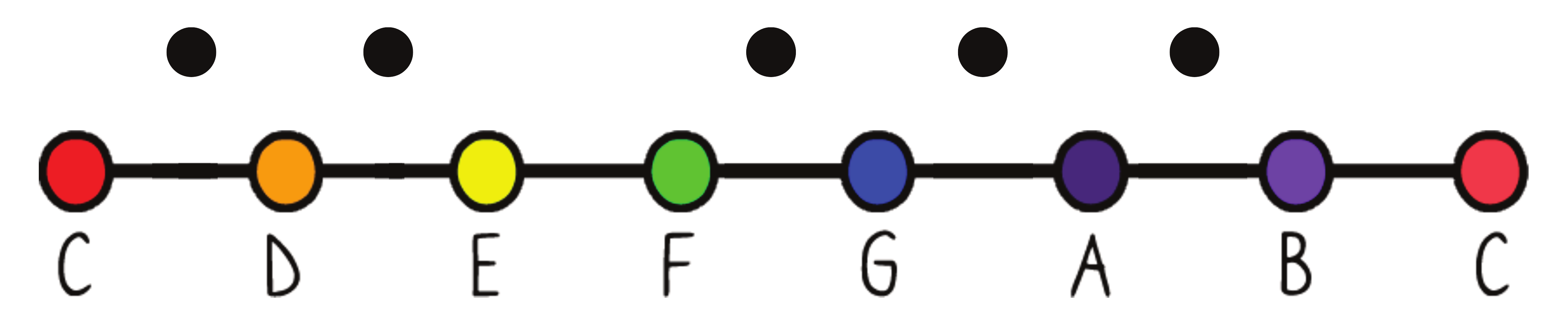
Just count the letter names spanned... It spans 4 notes.

So what kind of interval is it? It is a Perfect 4th!
- When you invert a Perfect 5th, it becomes a Perfect 4th interval.
- When you invert a Perfect 4th, it then becomes a Perfect 5th interval.
Inverting a Diminished 5th (like B–F) creates the interval F–B. The half steps traversed from F to B is 6 but a Perfect 4th is only 5 half steps. Therefore the 4th, F–B, is a little larger and therefore we call it an “Augmented 4th”.
Two simple rules cover what happens to an interval’s quality when you invert it. A Perfect interval stays Perfect. A Diminished and an Augmented interval swap, so the Diminished 5th becomes an Augmented 4th, and the Augmented 4th becomes a Diminished 5th.
There’s also a handy shortcut for the numbers. An interval and its inversion always add up to 9. A 4th inverts to a 5th (4 + 5 = 9), and a Unison (a 1st) inverts to an Octave (an 8th), since 1 + 8 = 9. (It comes to 9, not 8, because the note you flip gets counted in both intervals.)
And here’s why inversion works the way it does. An interval and its inversion always add up to one octave (12 half steps). A Perfect 5th (7 half steps) plus a Perfect 4th (5 half steps) equals 12. A Diminished 5th (6) plus an Augmented 4th (6) also equals 12.